
Enumerative geometers and their colleagues in representation theory and mathematical physics are very excited about the new perspectives on old and new problems offered by the nascent field of 3-dimensional mirror symmetry. While most formulations or explanations of what 3-dimensional mirror symmetry is require a lot of prerequisites and a high level of abstraction, some of its core predictions can be easily cast in the language that people like P.L. Chebyshev, C.G. Jacobi, and I.G. Macdonald would have no problem grasping. This is what I will try to do in this talk, which I hope will be accessible to the general mathematical audience.
嘉宾介绍
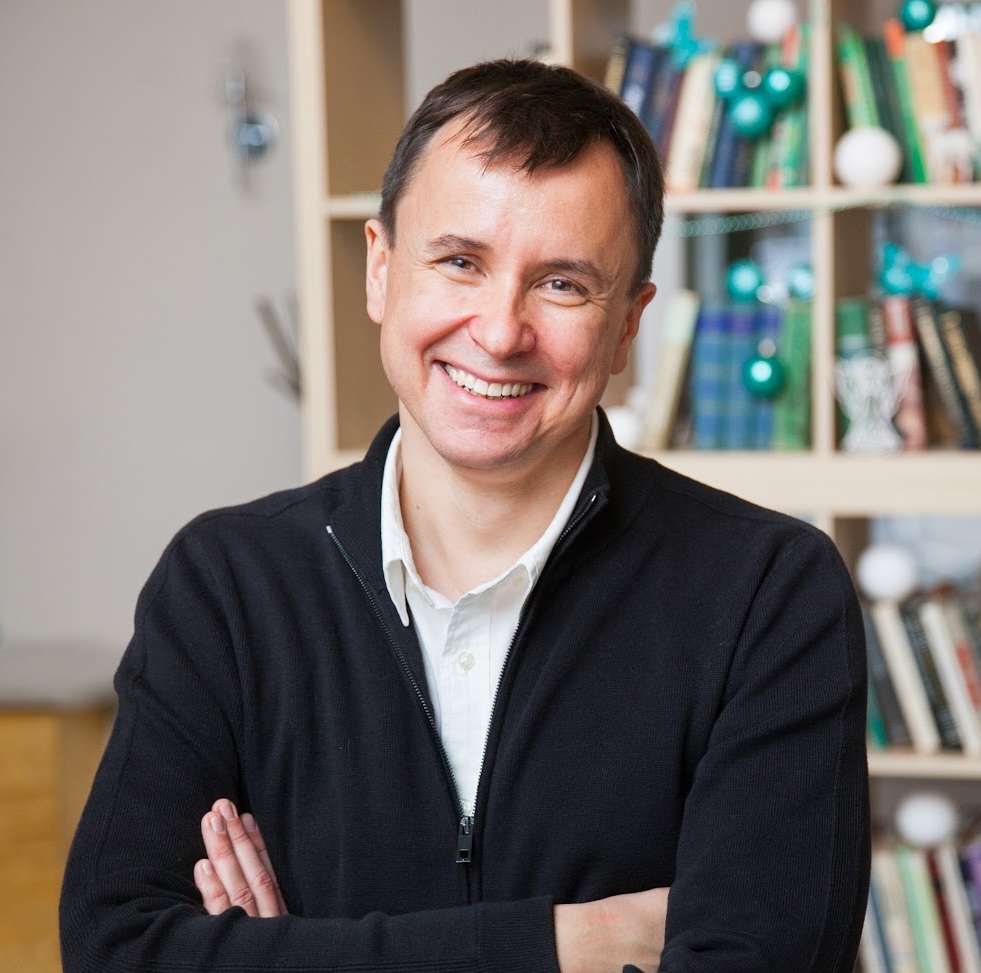
Andrei Okounkov
菲尔兹奖获得者、 中国科学院外籍院士、美国国家科学院院士演讲主题:
Professor Andrei Okounkov, born in Moscow in 1969, currently holds the Samuel Eilenberg Chair in Mathematics at Columbia University. His research lies at the crossroads of mathematical physics, probability theory, representation theory, and algebraic geometry, an area in which he has made extraordinary contributions. He is known for completing the classification of admissible representations of the infinite symmetric group and for introducing the convex bodies now widely used across multiple fields, which are called Okounkov bodies. He explored the connection between Gromov-Witten invariants and Hurwitz numbers, showing that they satisfy the 2-Toda integrable hierarchy. Along with collaborators, he established the deep correspondence between Gromov-Witten theory and Donaldson-Thomas theory, known as the MNOP conjecture. His more recent series of works developed the powerful concept of stable envelopes, leading to various applications in representation theory and enumerative geometry, such as quantum cohomology/K-theory, quantum q-Langlands, and 3d mirror symmetry. In recognition of his remarkable achievements, Professor Okounkov received the Fields Medal in 2006 and has been elected to several leading academies, including the US National Academy of Sciences, the American Academy of Arts and Sciences, and the Chinese Academy of Sciences. Beyond his research, he has dedicated extensive service as an advisor and trustee for multiple renowned mathematical institutes, and his work has exerted a profound influence on modern mathematics.